
Učitavanje
| Podkategorija i mrežna i wireless oprema - kategorija: | Mrežna i wireless oprema - Ostala mrežna i Wi-Fi oprema |
|---|
| Stanje | Novo |
|---|
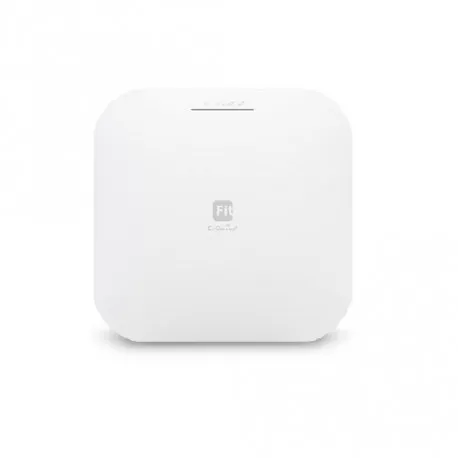
Standards IEEE 802.11ax at 2.4GHz IEEE 802.11ax at 5 GHz Backward compatible with 802.11a/b/g/n/ac Processor 2.0GHz Quad-core Qualcomm® ARM Cortex A53s Processor The antenna 4 x 2.4GHz: 5 dBi 4 x 5 GHz: 6 dBi Integrated omnidirectional antenna Physical interface 1 Ethernet port 10/100/1000/2500 N-BASE-T, RJ-45 1 DC connector 1 x Reset Button LED indicators 1 x Power 1 x LAN 1 x 2.4GHz 1 x 5 GHz Power supply Power supply via Ethernet: 802.3at input 12 V DC / 2 A The maximum power consumption is 19.5 watts Operating frequency Simultaneous use of two 2.4GHz and 5 GHz radio modules Operating modes AP, grid Frequency radio 2.4GHz: 2400-2482 MHz 5 GHz: 5150-5250 MHz, 5250-5350 MHz, 5470-5725 MHz, 5725-5850 MHz Transmission power Up to 23 dBm at 2.4GHz Up to 23 dBm at 5 GHz (Maximum power is limited by regulatory requirements) Tx Beam Shaping (TxBF) Radio circuits/spatial stream 4x4:4 SU-BY Four (4) spatial SU-MIMO streams for 2.4GHz and four spatial SU-MIMO streams for 5 GHz with wireless data transfer speeds up to 3548 Mbps per wireless client device with 2.4GHz and 5 GHz radio modules. MOO-BY Four (4) spatial Multiple (MU)-MIMO streams with wireless data transfer speeds up to 2400 Mbit/s for simultaneous transmission of two (2) two streams of MU-MIMO 11ax-enabled wireless client devices at frequencies below 5 GHz. Four (4) multiple (MU)-MIMOS with wireless data transfer speeds up to 1148 Mbit/s for simultaneous transmission of two streams of wireless client devices with support for MUMIMO 11ax at a frequency below 2.4 GHz. Supported data transfer rates (Mbps): 802.11ax: 2.4GHz: 9 to 1148 (MCS0 to MCS11, NSS = 1 to 4) 5 GHz: 18 to 2400 (MCS0 to MSC11, NSS = 1 to 4) 802.11b: 1, 2, 5.5, 11 802.11a/g: 6, 9, 12, 18, 36, 48, 54 802.11 n: 6.5 to 600 Mbps (MCS0 to MCS31) 802.11ac: 6.5 to 1733 Mbps (MCS0 to MCS9, NSS = 1 to 4) Supported radio technologies 802.11ax: Orthogonal Frequency Division Multiple Access (OFDMA) 802.11b: Direct Sequence Spectrum Extension (DSSS) 802.11ac/a/g/n: Multiple Orthogonal Frequency division (OFDM) Sewage system 802.11ax supports high efficiency (HE) — HE 20/40/80MHz. 802.11ac supports Very high bandwidth (VHT) — VHT 20/40/80MHz. 802.11n supports high bandwidth (HT) — HT 20/40MHz. 802.11n supports very high bandwidth in the 2.4GHz band – VHT40 MHz (256-QAM). 802.11n/ac/ax packet Aggregation: A-MPDU, A-SPDU Supported modulation 802.11ax: BPSK, QPSK, 16-QAM, 64-QAM, 256-QAM, 1024-QAM 802.11ac: BPSK, QPSK, 16-QAM, 64-QAM, 256-QAM 802.11a/g/n: BPSK, QPSK, 16-QAM, 64-QAM 802.11b: BPSK, QPSK, CCK Multiple BSSID 8 SSIDs for 2.4GHz and 5 GHz radio modules. VLAN marking Supports SSID-VLAN 802.1q tagging. Cross-band end-to-end VLAN access VLAN Management The spanning tree Supports the 802.1d spanning tree protocol. QoS (Quality of Service) Complies with the IEEE 802.11e VMM standard SNMP v1, v2c, v3 IIB I/II, private MIB Wireless security WPA3 WPA2 Corporate (AES) WPA2 AES-PSK Hide the SSID in beacons MAC address filtering, up to 32 MAC addresses per SSID List of connected wireless STA (clients) SSH tunnel Client isolation Temperature range Working temperature: 32°F~104°F (0°C~40°C) Storage: -40°F~176°F (-40°C~80°C) Humidity (non-condensing) In working condition: 90% or less Storage: 90% or less EWS377-FIT device Weight: 1.70 pounds. (776 g) Length: 8.27 inches (210 mm) Width: 8.27 inches (210 mm) Height: 1.31 inches (33.2mm) Packaging Weight: 2.36 pounds. (1072 g) Length: 9.65 inches (245 mm) Width: 9.65 inches (245 mm) Height: 3.35 inches (85 mm)